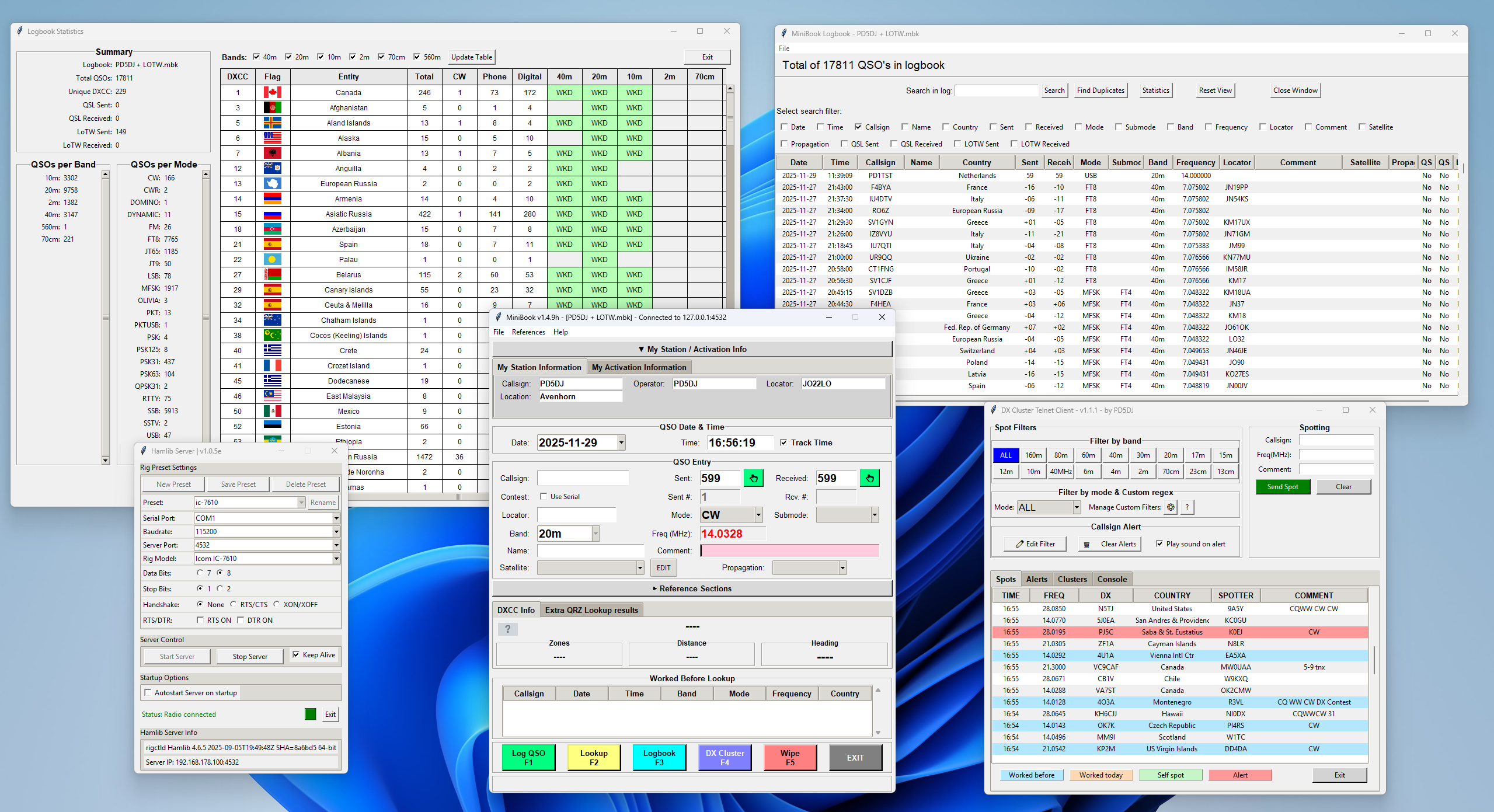
What is MiniBook?
MiniBook is a modern, lightweight yet extremely powerful logging and station‑integration suite for radio amateurs. It is designed with one clear objective: fast, reliable, and structured operation during everyday QSOs, portable activities, DXing, and contesting.
MiniBook is not just a logbook. It is a central operating hub that connects logging, rig control, DX cluster spotting, online services, and station automation into a single, coherent workflow.
Origins & History of MiniBook
MiniBook started as a personal experiment rather than a planned product.
Through professional work involving test scripting, hardware/software validation, database handling, and automation using Python, the idea arose to explore how quickly a small, practical logging tool could be built from scratch.
The original goal was intentionally modest:
- Create a small test logbook
- Keep it simple and robust
- Focus on field operation rather than a full desktop logging suite
- Design everything around one compact screen, suitable for tablet use
The first versions of MiniBook were never meant to replace existing logging software. They were created to answer a simple question:
How little is actually needed to log QSOs efficiently in the field?
Very quickly, this experiment evolved beyond its initial scope.
Field-Oriented Design
From the beginning, MiniBook was designed with portable and outdoor operation in mind:
- Large, clear input fields
- Minimal window clutter
- Logical left-to-right and top-to-bottom workflow
- No hidden dependencies on internet connectivity
Everything needed to log a QSO had to be accessible from one compact main window, without opening multiple dialogs or panels. This design philosophy remains visible in MiniBook today.
Why Python and Open Source
Python was a deliberate choice.
Using Python meant:
- No complex build or compilation process
- Fast iteration and experimentation
- Easy debugging and modification
- Direct access to mature libraries for networking, GUI, and data processing
MiniBook is written as plain, readable Python code. This allows technically inclined radio amateurs to:
- Inspect how things work internally
- Modify behavior for their own station
- Extend functionality without reverse engineering
Being open source was a natural extension of this philosophy. MiniBook is not a black box; it is a tool meant to be understood, adapted, and improved.
From Test Log to Station Ecosystem
As MiniBook matured, real-world operating revealed new requirements:
- DXCC and prefix intelligence
- Rig frequency tracking
- DX Cluster integration
- Contest-style workflows
- Award and reference handling
Instead of bolting features on randomly, MiniBook evolved into a modular ecosystem:
- Logging focused purely on data integrity and workflow
- Rig control delegated to a dedicated Hamlib layer
- DX Cluster handling separated for performance and clarity
This organic growth is why MiniBook feels cohesive rather than overloaded. Every feature exists because it solved a real operational problem encountered during actual use.
Core Philosophy
MiniBook is built around a few fundamental principles:
- Local‑first design – Your data stays on your system in open formats
- Operator control – No forced cloud dependency
- Modular architecture – Each component can run standalone or fully integrated
- Performance oriented – Optimized disk I/O, caching, and background threading
- Radio‑centric workflow – The radio is always the reference point
MiniBook Logbook System
JSON‑Based Logbook Engine
MiniBook uses a custom JSON logbook format designed for speed, flexibility, and long‑term maintainability. Unlike traditional ADIF‑only logbooks, MiniBook separates internal storage from interchange formats.
Advantages:
- Very fast loading and saving
- Automatic logbook format upgrades
- Built‑in backup handling
- Efficient operation with large logbooks
ADIF Import & Export
MiniBook provides full ADIF support:
- Import from other logging applications
- Export full logbooks or selected QSOs
- Contest, POTA, and WWFF‑specific exports
- Robust encoding detection (UTF‑8 / Latin‑1)
Advanced QSO Management
- Edit and delete QSOs safely
- Multi‑select bulk editing
- Duplicate QSO detection
- Worked‑before and worked‑today highlighting
- Automatic band and frequency validation
DXCC, Locator & Geographic Intelligence
DXCC & Prefix Handling
MiniBook integrates cty.dat based DXCC recognition:
- Intelligent prefix parsing
- Portable and compound callsign support
- Automatic DXCC resolution
Locator, Distance & Heading
- Maidenhead locator validation
- Automatic distance calculation
- Real‑time heading updates
Award & Reference Systems
Native support for:
- DXCC
- IOTA
- SOTA
- POTA
- WWFF
- BOTA
- COTA
- Satellite operations
All reference data is automatically downloaded and cached locally.
Rig Integration via Hamlib
MiniBook connects to an external Hamlib rigctld service rather than embedding rig control internally. This design choice greatly improves stability and flexibility.
Supported features:
- Live frequency polling
- Live mode polling
- Automatic band detection
- Network‑based rig connections
- Automatic reconnect handling
HamlibServer – Dedicated Rig Control Layer
What is HamlibServer?
HamlibServer is a standalone GUI application that manages a local rigctld instance. It acts as a reliable bridge between your physical radio and applications such as MiniBook.
Key Capabilities
- Graphical rigctld configuration
- Presets for common transceivers
- Serial and Bluetooth SPP support
- Robust connection monitoring
- Automatic recovery from disconnects
By separating rig control from logging, MiniBook achieves contest‑grade reliability and network flexibility.
DX Cluster Integration
What is a DX Cluster?
A DX Cluster is a real‑time network where radio amateurs post and receive activity reports (spots) of stations currently on the air.
Each spot typically includes:
- Callsign
- Frequency
- Mode
- Spotter
- Optional comments
DXCluster Application
MiniBook integrates with a dedicated DX Cluster client supporting DX Spider compatible Telnet clusters.
Features:
- Buffered high‑performance spot processing
- Band and mode filtering
- Custom regular‑expression filters
- Callsign alerts with sound notifications
- Automatic reconnect logic
Smart Spot Interaction
- Clicking a spot tunes the radio
- Callsign and frequency are sent to MiniBook
- Worked‑before and worked‑today highlighting
- Self‑spot visibility
MiniBook ↔ DXCluster Workflow
The MiniBook and DXCluster integration enables a near‑instant workflow:
Spot → Tune → Log
No manual copy‑and‑paste is required, significantly reducing operator workload during high‑rate operation.
Credentials, API Keys & Logbook Isolation
A deliberate architectural choice in MiniBook concerns how API keys and credentials are handled.
Many logging applications store important credentials — such as API keys and passwords — globally, shared across all logbooks. While this may seem convenient, it introduces practical and technical problems.
A clear example is QRZ.com.
QRZ API keys are not generic:
- An API key is tied to one specific, registered callsign
- Using the same key across multiple logbooks or callsigns is incorrect
- Global credential storage can easily lead to accidental misuse or invalid uploads
MiniBook’s Approach
MiniBook explicitly avoids global credential storage for services like QRZ.
Instead:
- API keys and related credentials are stored per logbook
- Each logbook contains only the credentials that belong to that specific station or callsign
- Switching logbooks automatically switches the active credentials
Practical Advantages
This design has several important benefits:
- Correct QRZ uploads for multi-call operators
- Safe handling of portable and contest callsigns
- No accidental cross-logbook uploads
- Logbooks remain fully self-contained
- Easier backup, transfer, and archiving of logbooks
From a data-management perspective, this approach mirrors best practices used in professional software and database systems: credentials belong to the data context, not the application globally.
This philosophy greatly improves reliability and correctness when operating multiple callsigns, stations, or activities within the same MiniBook installation.
Online Services Integration
QRZ.com
- Callsign lookup (QRZ subscription required)
- Automatic retrieval of operator and QTH data
- Integrated lookup within the logging workflow
QRZ Logbook Upload
- Single QSO upload
- Bulk upload support
- Detailed error logging
WordPress & Web Integration
MiniBook includes a WordPress integration layer that allows:
- Live ON AIR / OFF AIR status display
- Real‑time band, frequency, and mode updates
- Public station dashboards
This makes MiniBook suitable for both operating and public station presentation.
Reliability & Performance
MiniBook is engineered for long‑running operation:
- Asynchronous disk I/O
- Threaded background processing
- Automatic backups
- Crash‑resistant log handling
- Instance locking to prevent multiple launches
Contesting & Awards – Clarification
It is important to clearly state what MiniBook is not designed for.
MiniBook is not a contest logger, and it does not maintain award tracking systems.
While MiniBook can certainly be used during contest-like activity, it is intentionally not built around contest rules, scoring engines, or award validation.
Exchange Handling
MiniBook includes a very basic Sent and Received exchange mechanism:
- Simple serial-style exchanges
- Designed for lightweight operation
- No contest rule enforcement
- No multiplier logic
- No scoring or rate calculations
This functionality exists to support simple structured exchanges, not full contest workflows.
Statistics Window
MiniBook does include a logbook statistics window, but its purpose is informational rather than competitive:
- Total QSOs
- Band and mode distribution
- Basic activity overview
The statistics window is not tied to award systems and does not attempt to validate or track progress toward awards such as DXCC, WAS, WAZ, or contest results.
Design Intent
MiniBook deliberately avoids becoming a contest-centric application.
This design choice keeps MiniBook:
- Lightweight
- Predictable
- Easy to understand
- Free from complex rule engines
Operators who require advanced contest logging, scoring, or award management are encouraged to use specialized contest software alongside MiniBook when needed.
Who Is MiniBook For?
MiniBook is designed for:
- Portable operators (POTA, SOTA, WWFF)
- DX-focused casual operating
- Field operation and expeditions
- Home stations that value simplicity and control
- Operators who want full ownership of their logbook data
When NOT to Use MiniBook
MiniBook is designed with a very clear purpose and philosophy. As such, there are situations where MiniBook may not be the right tool.
You may want to consider a different solution if:
- You are looking for a full contest logger with scoring, multipliers, rate meters, and rule engines
- You need automatic award tracking and validation (DXCC, WAS, WAZ, etc.) built into the logger
- You require heavy macro-driven SO2R or multi-radio contest workflows
And, somewhat humorously but very honestly:
- If you simply do not like logging QSOs at all 😉
MiniBook assumes that logging is a valuable part of operating — whether for later reference, statistics, QSLing, or personal satisfaction. If logging itself is something you actively avoid, MiniBook will not try to convince you otherwise.
Conclusion
MiniBook is not simply another logging application.
It is a complete station ecosystem that integrates logging, rig control, DX spotting, geographic intelligence, and web publishing into a single, operator‑focused solution.
Designed by a radio amateur, for radio amateurs — with performance, clarity, and reliability as its foundation.